 Elite Hub
How to Test Internet Speed on Smart TV
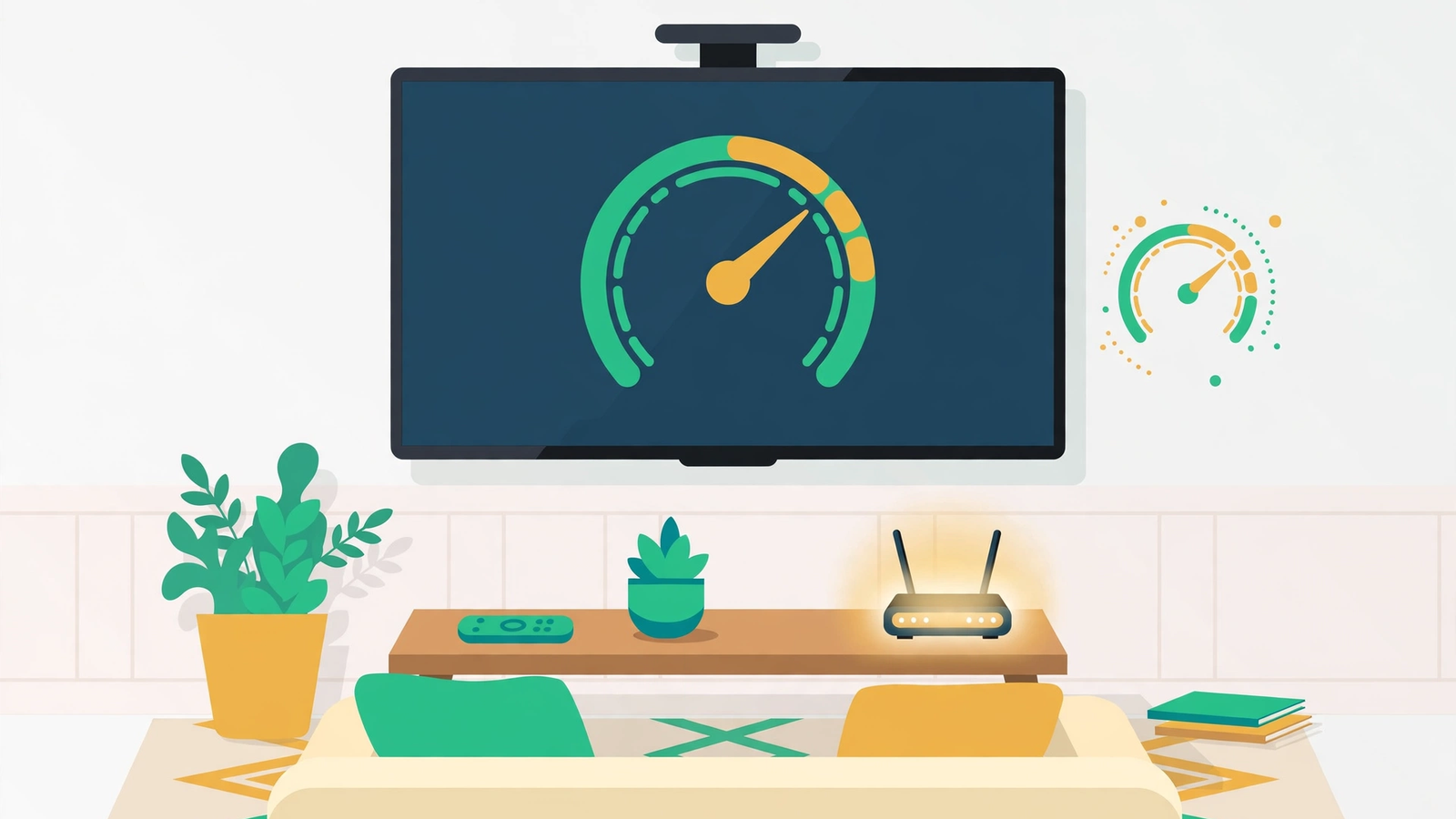
To test internet speed on a smart TV, open the TV's built-in web browser, go to elitehub.site, and run the speed test — it takes about 30 seconds. You can also install a speed-test app from your TV's app store, or use the network check in Settings. A TV test matters because it measures the connection your shows actually use, which is often slower than what your phone reports.
- Can you test internet speed on a smart TV directly?
- How to test internet speed on a smart TV with the built-in browser
- How to test with a speed-test app
- Why is my smart TV slower than my phone on the same WiFi?
- What speed do you need for smooth 4K streaming?
- How do I fix a slow smart TV connection?
- Frequently asked questions
Can you test internet speed on a smart TV directly?
Yes — almost every smart TV sold in the last ten years can run a speed test on its own, with no phone or laptop involved. Samsung (Tizen), LG (webOS), and Android TV / Google TV all ship with a built-in web browser, and all three app stores carry speed-test apps. The test works the same way as on a computer: it downloads and uploads a chunk of data and reports the speed in Mbps.
One thing worth knowing: a TV speed test measures the TV's connection, not your internet plan. Your plan might be 300 Mbps while your TV only manages 40 Mbps — and that gap is exactly what you are trying to find. Testing on the TV tells you whether the buffering is your internet, your WiFi, or the TV itself.
How to test internet speed on a smart TV with the built-in browser
This is the fastest way to test internet speed on a smart TV, and it works on every brand. It takes about two minutes.
- Close background apps. Exit Netflix, YouTube, or anything else running, and pause any downloads — a stream running in the background will steal bandwidth and skew the result.
- Open the TV's browser. On Samsung, look for "Internet" in the app row. On LG, open the "Web Browser" app. On Android TV / Google TV, open Chrome or the built-in browser.
- Go to elitehub.site. Type the address with the on-screen keyboard and press Enter — the speed test loads right on the TV screen.
- Run the test and wait. Tap start with your remote. It takes 20–30 seconds: download first, then upload, then ping. Do not switch apps while it runs.
- Run it twice. The first result can be thrown off by a cold connection — run it a second time and use the second number. If the two differ wildly, run a third and take the middle value.
How to test with a speed-test app
If your TV's browser feels clumsy with a remote, an app is the easier route — and it is also the most accurate one, because apps are built for the TV's hardware instead of running inside a slow browser.
- Android TV / Google TV: open the Google Play Store, search for a speed-test app, install it, and open it. The big-screen layout is remote-friendly, and results are usually a little higher than the browser's, because the app is not slowed down by the browser itself.
- Samsung (Tizen): open the Apps panel and search the Samsung app store for a speed test. If no dedicated app shows up, the built-in Internet browser method above works just as well.
- LG (webOS): open the LG Content Store and search for a speed-test app — though many LG owners find the browser route simpler, because webOS browsers handle speed-test sites well.
- Fire TV / Roku: both have speed-test apps in their stores, plus a network check in Settings that confirms the connection is up without measuring full speed — use the app or browser for a real number.
Whichever method you pick, compare like with like: a browser result and an app result on the same TV can differ by 10–20%, and that is normal. Pick one method and stick with it when you re-test after making a fix.
Why is my smart TV slower than my phone on the same WiFi?
This is the most common surprise in TV speed testing: your phone shows 250 Mbps from the sofa while the TV in the same room shows 60 Mbps. It is usually not your internet — it is the TV.
The TV's WiFi adapter is weaker. TV makers spend the budget on the panel, not the wireless chip. Most TVs have a basic single-antenna adapter, while your phone has a modern multi-antenna one. The TV also often connects on the 2.4 GHz band, which is slower but reaches further — check in Settings > Network whether the TV is on 2.4 GHz or 5 GHz, and switch to 5 GHz if the router is in the same room. Our guide on 2.4 GHz vs 5 GHz WiFi explains the trade-off in plain English.
The TV is in the worst spot in the room. TVs sit against a wall, often inside a cabinet or behind a soundbar, with a big metal panel blocking the signal. A phone in your hand has a clear line to the router; a TV does not. Even moving the router a metre or two out of a closed cabinet can lift the TV's speed — the rules in our router placement guide apply here too.
TV browsers are slow. The browser on a smart TV is a cut-down program running on a modest chip, and it can bottleneck the test itself, reporting a lower number than the connection actually delivers. If the browser says 40 Mbps but the TV app says 90 Mbps, trust the app.
What speed do you need for smooth 4K streaming?
The number on the test only matters against what your TV needs to do. Use this table to read your result:
| What you watch | Minimum per stream | Comfortable household speed |
|---|---|---|
| HD (1080p) streaming | 5 Mbps | 25 Mbps |
| 4K streaming (Netflix, Disney+, YouTube) | 25 Mbps | 50–100 Mbps |
| 4K HDR / Dolby Vision | 25–30 Mbps | 100 Mbps |
| Two 4K streams at once | 50 Mbps | 100–200 Mbps |
| 4K streaming + gaming + video calls | 50 Mbps + low ping | 200 Mbps |
Netflix's own figure is 15 Mbps for 4K, but that is the bare minimum for one stream with nothing else happening. In real life, 25 Mbps per 4K stream is the number to aim for — and the household total should be at least double that, because someone else is always on a phone. If your TV tests below 25 Mbps, 4K will buffer; below 15 Mbps, even HD can stutter. For the full household maths, see our guide on what internet speed you need for 4K streaming.
How do I fix a slow smart TV connection?
Run the test, then work through these fixes in order — cheapest first — and re-test after each one so you know which fix actually helped.
- Plug in an Ethernet cable. If the router is in the same room, a single cable is the biggest single upgrade: it usually doubles or triples the TV's speed and removes WiFi interference entirely. Try this first, before buying anything.
- Switch the TV to 5 GHz. In Settings > Network, forget the 2.4 GHz network and join the 5 GHz one — but only if the router is in the same room or one room away. Through two walls, 2.4 GHz is the better choice.
- Restart the TV and the router. Unplug the TV for 30 seconds (a remote power-off often just sleeps it), then restart the router. A TV that has been on for weeks can hold a stale, slow connection; a restart clears it.
- Move the router out of its hiding place. A router inside a TV cabinet or behind the TV itself is broadcasting through furniture and a metal panel. Put it in the open, at waist height or higher, and re-test.
- Update the TV's software. Check Settings > Support > Software Update (Samsung) or the equivalent on your brand. Firmware updates regularly improve WiFi performance — and they close security holes too.
- Check for a crowded network. If the TV is slow only in the evening, the problem may be peak-hour congestion or another device hogging bandwidth — a cloud backup or a game download. Our guide on why the internet is slow at night shows how to prove it with timed tests.
One concrete test ties it all together: run the TV test on WiFi, write the number down, plug in the Ethernet cable, and run it again. If the wired number is much higher, your WiFi — not your internet plan — was the problem, and you can stop thinking about upgrading the plan. If the wired number is still low, the problem is the plan or the line itself, and that is a call to your ISP.
Frequently Asked Questions
Can I test internet speed on my smart TV without a phone or laptop?
Yes. Open your TV's built-in web browser, go to a speed-test site such as elitehub.site, and run the test — it works exactly like it does on a computer. Most smart TVs also have speed-test apps in their app store, and many have a network test in Settings that checks the connection without measuring full speed.
Why is my smart TV slower than my phone on the same WiFi?
Three common reasons: the TV's WiFi adapter is weaker and often sits on the slower 2.4 GHz band, the TV is farther from the router (often behind a wall or in a cabinet), and TV browsers are less powerful than phone browsers, so the test itself runs slower. A wired Ethernet cable usually closes most of the gap.
What internet speed do I need for 4K streaming on a smart TV?
Netflix recommends 15 Mbps for one 4K stream, but 25 Mbps per stream is the realistic minimum once you count overhead, and a household should have 50–100 Mbps so a 4K stream stays smooth while other devices are online. If your TV tests below 25 Mbps, you will see buffering on 4K.
Is a wired Ethernet connection better than WiFi for a smart TV?
Almost always, yes. Ethernet gives the TV a stable, full-speed connection with lower latency and no interference from walls, neighbours, or other devices. If your router is in the same room, a single cable is the cheapest and most effective upgrade for a smart TV that buffers.
Test Your Speed on Every Device
Your TV's number is the one that matters for streaming — but compare it with your phone and laptop too. If only the TV is slow, the fix is in the room, not the plan.
Test Your Speed Free